THE HORSE AND SUSTAINABLE AGRICULTURE: A MODERN ALTERNATIVE TO MECHANIZATION
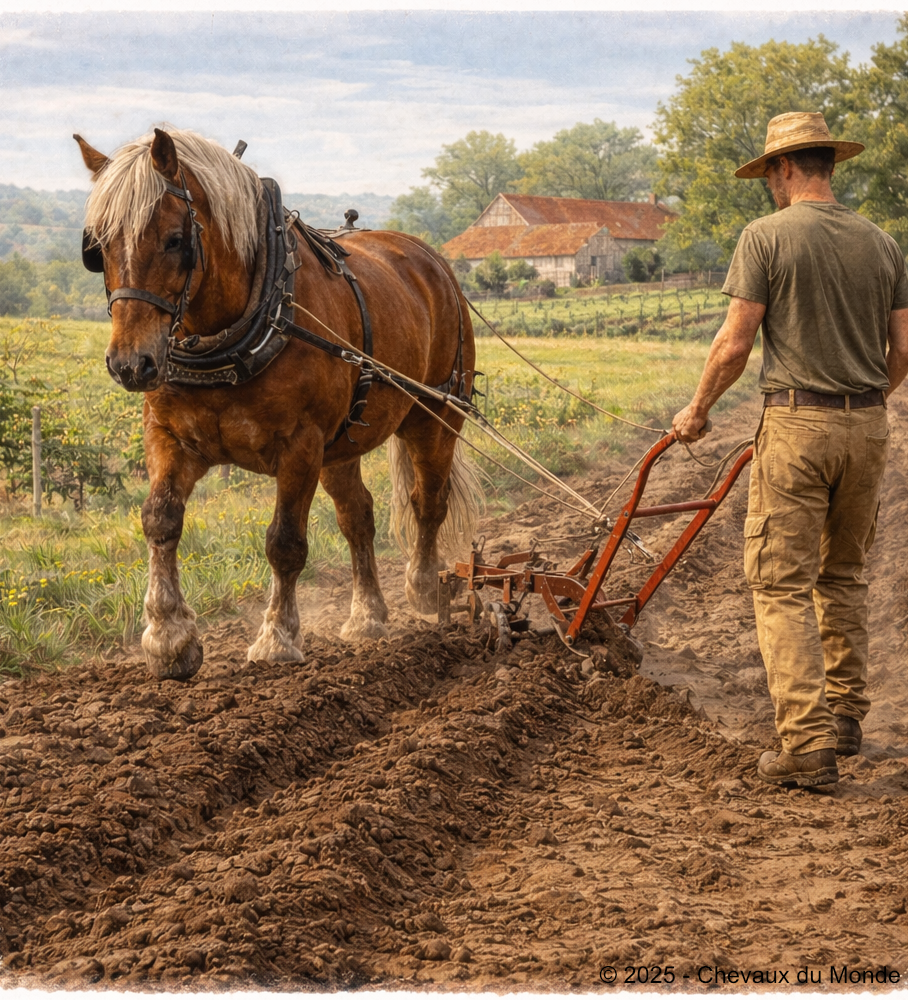
Animal traction in sustainable farming, using a working horse to preserve soil structure and reduce the environmental impact of mechanization.
Long considered a relic of the agricultural past, the working horse is now experiencing renewed interest in certain sectors of sustainable agriculture. In the face of environmental, economic and social challenges linked to intensive mechanization, the thoughtful use of horses appears, in some contexts, as a modern, relevant and complementary alternative to machines.
The Return of the Working Horse in Contemporary Agriculture
Far from a folkloric image, working horses are now used in modern agricultural operations, often engaged in:
- organic farming,
- permaculture,
- precision viticulture,
- small- and medium-scale market gardening,
- management of sensitive or fragile plots.
This revival is based on a broader reflection on the sustainability of agricultural practices, rather than on an ideological rejection of mechanization.
Why Can the Horse Be a Sustainable Alternative?
A Low Environmental Footprint
Unlike motorized machinery, the horse:
- does not consume fossil fuels,
- does not emit greenhouse gases during use,
- produces manure that can be reused as a natural soil amendment,
- generates minimal noise pollution.
Its environmental impact remains low, provided that feeding and management practices are well balanced.
Soil Preservation
Repeated use of heavy machinery can lead to:
- soil compaction,
- reduced microbial biodiversity,
- decreased water infiltration capacity.
Being lighter, the horse allows:
- more respectful soil work,
- improved soil aeration,
- the ability to work even on wet or fragile ground.
This represents a major advantage in vineyards, orchards and high-value crops.
Greater Precision in Field Work
Working with a horse enables slow and precise operations:
- inter-row hoeing,
- crop maintenance without damaging root systems,
- access to narrow or sloped plots.
This precision helps reduce chemical inputs and supports more refined crop management.
Limits That Should Not Be Ignored
Despite its advantages, the horse is not a universal solution.
Physical and Human Constraints
Working with a horse requires:
- time,
- specialized training,
- in-depth knowledge of the animal,
- significant physical capacity.
The shortage of trained professionals currently represents a real limitation.
Profitability and Scale of Production
On large-scale cereal farms, mechanization remains essential.
The horse is mainly suited to:
- human-scale farms,
- specialized production systems,
- diversified agricultural models.
It is therefore a matter of complementarity, not total replacement.
A More Human and Local Form of Agriculture
Beyond technical considerations, the use of horses promotes:
- a closer relationship between farmers and their environment,
- the revaluation of traditional know-how,
- increased attractiveness of short supply chains,
- greater social acceptance of certain agricultural practices.
In some regions, this approach also contributes to revitalizing rural areas.
Training and Knowledge Transmission
The development of animal traction in agriculture is accompanied by:
- specialized training programs,
- knowledge transmission centers,
- a renewal of professions linked to working horses.
This dynamic helps preserve certain endangered draft horse breeds while giving them a concrete and contemporary role.
Conclusion
The horse does not represent a step backward, but rather a modern response to contemporary challenges when used thoughtfully and appropriately. Within a sustainable, diversified and soil-respecting agriculture, the horse naturally finds its place alongside mechanical tools, as a valuable ally rather than a systematic substitute.